About Kettlebells Los Angeles
A training practice that started in West Los Angeles and grew into a network of instructors across Southern California — built on the idea that a workout should leave you better, not wrecked.
Kettlebells Los Angeles was founded by Dr. Mark Cheng as a way of teaching hardstyle kettlebell training to people in West Los Angeles — Brentwood, Santa Monica, Venice, and Pacific Palisades. What made it distinctive was where it came from: not bodybuilding, and not general fitness, but rehabilitation.
Dr. Cheng came to kettlebells while rehabilitating his own lower back and shoulder injuries. He is a specialist in Chinese medicine orthopedics, and the training he built reflects that — screening before loading, technique before weight, and a willingness to withhold a lift rather than push a client through pain. Every instructor listed on this site learned the method from him directly.
What is a kettlebell?
A kettlebell is like a bowling ball with a thick, kielbasa-shaped handle coming out of it. The off-centred nature of the weight makes training with it singularly difficult if you lack proper form.
Unlike bodybuilding-style workouts, which focus all the stress on a single muscle group through isolation, kettlebell-style training recruits as many different muscle groups as possible at the same time. This trains you to use your body synergistically, moving as a coordinated whole. Used properly, a kettlebell develops strength, flexibility, and cardio at the same time.
Even ten minutes of kettlebells gives you more core strength and full-body cardio training than an hour in the gym — and it leaves you invigorated instead of feeling whipped.
If you want the longer version, read What’s a Kettlebell?
Who trains with kettlebells
Kettlebell training moved from a niche Russian implement to a mainstream tool over the 2000s, and the range of people using it is unusually wide.
Athletes and coaches
Athletes of all shapes, sizes, and sports have adopted kettlebell training. Professional strength coaches and mixed martial artists have folded it into their strength and conditioning work, largely because it develops power and grip endurance without adding bulk that has to be carried around.
Tactical and first responders
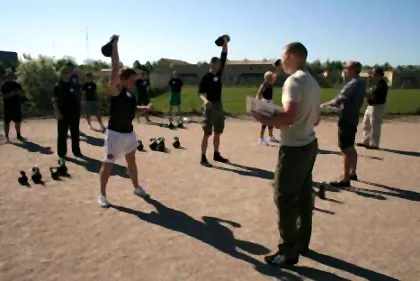
Police, firefighters, and armed forces personnel train with kettlebells. Special operations teams use them, the US Secret Service has its own kettlebell snatch test, SWAT teams train with them, and fire companies have taken them up because they build tactical strength in a small footprint. If you want a sense of the physique kettlebell training produces, think less Arnold Schwarzenegger and more Bruce Lee — who trained with kettlebells himself.
Film and performance
Kettlebells entered public awareness partly through film conditioning work. The cast and crew of 300 trained with Mark Twight of Gym Jones to prepare for the film; the Warner Bros. press material described training that “emphasized athleticism by combining compound movements, lifting, and throwing,” using primitive tools — medicine balls, kettlebells, rings — instead of machines. Director Zack Snyder trained with kettlebells at the same facility.
Busy people
The largest group, in practice, is people with ordinary lives and no time. Executives with rising blood pressure and a growing waistline. Parents fitting training between the school run and everything else. People who are tired and achy all the time, or simply bored with what they have been doing. Kettlebell training suits them because it is short, portable, and does not require a gym.
The approach
Three things distinguish how this is taught:
- Screen first. Movement quality is assessed before load is added. If a pattern is broken, loading it makes it worse.
- A small number of lifts, done well. The swing, the get-up, the squat, the clean, the press, and the snatch cover almost everything. Depth beats variety.
- Rehabilitation and prehabilitation are part of training, not a separate activity. This is the part that came from Dr. Cheng’s clinical background, and it is why people with old injuries end up here.
Ready to go further? Look at how training is structured, or find an instructor.
About this practice
What makes Kettlebells Los Angeles different from a regular gym?
There is no storefront gym. Kettlebells Los Angeles is a lineage of instructors who all learned the method directly from Dr. Mark Cheng, teaching in parks, studios, and private settings across Southern California. The through-line is a rehabilitation-first approach: movement is screened before it is loaded, and technique is corrected before weight is added.
Who founded Kettlebells Los Angeles?
Dr. Mark Cheng, L.Ac., Ph.D. — a specialist in Chinese medicine orthopedics who trained as a private student of Pavel Tsatsouline and now holds the rank of StrongFirst Certified Master Instructor. He came to kettlebell training while rehabilitating his own lower back and shoulder injuries. Read his full biography.
Is kettlebell training good for fat loss?
It is effective because it combines resistance training with a high metabolic demand in the same session, and because sessions are short enough that people actually do them consistently. Consistency and diet matter far more than the specific implement, but kettlebells remove two common excuses: time and gym access.
Will kettlebell training make me bulky?
Generally the opposite. Hardstyle kettlebell work emphasises ballistic, full-body lifts with moderate volume rather than the isolation and high-volume hypertrophy work that drives size. The physique it tends to produce is dense and lean rather than large, which is precisely why tactical and military populations use it — added bulk is a liability when you have to carry it.